A Censored Community: Students’ Speech, Expression Encumbered, DePauw Criticized
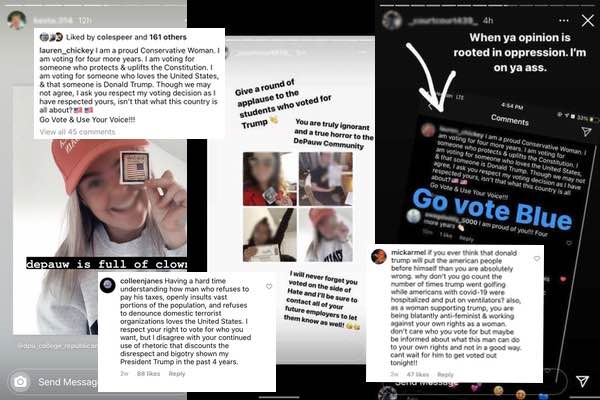
On the day of the presidential election, junior Lauren Hickey, donning a gray DePauw crewneck decorated with buttons that read, “Trump 2020” and “I heart capitalism,” posted a selfie on Instagram holding up an “I voted” sticker.
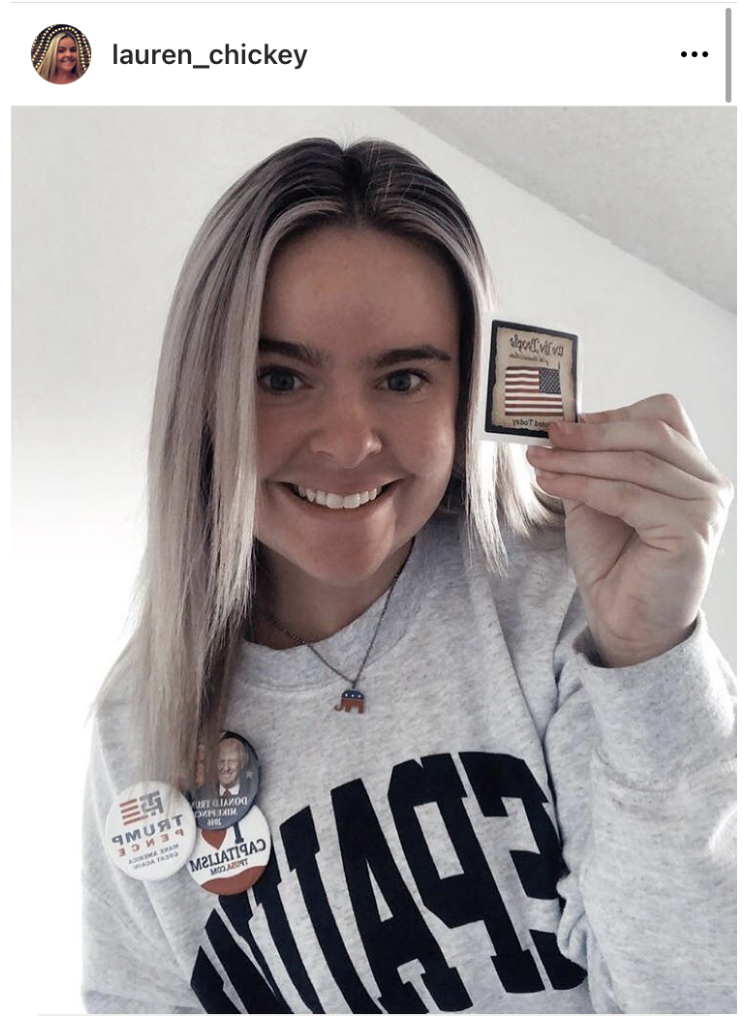
The caption read, “I am a proud Conservative Woman. I am voting for four more years. I am voting for someone who protects & uplifts the Constitution. I am voting for someone who loves the United States, & that someone is Donald Trump. Though we may not agree, I ask you respect my voting decision as I have respected yours, isn’t that what this country is all about? Go Vote & Use Your Voice!!!”
Throughout the day, DePauw students commented on the post, both in support and opposition.
Three students wrote long rebuttals in the comment section criticizing Hickey’s post. Other students interacted with the comments, accumulating between 30-90 likes, in addition to a number of replies.
Some people respectfully disagreed. Junior Marisol Karmel’s comment gained 47 likes, saying, “If you ever think that Donald Trump will put the american people before himself then you are absolutely wrong. Why don’t you go count the number of times Trump went golfing while Americans with COVID-19 were hospitalized and put on ventilators? Also, as a woman supporting trump, you are being blatantly anti-feminist & working against your own rights as a woman. Don’t care who you vote for but maybe be informed about what this man can do to your own rights and not in a good way. Can’t wait for him to get voted out tonight!!”
Screen-Shot-2020-11-17-at-11.51.19-PM
A screenshot taken by The DePauw of Hickey's Instagram caption.
Other responses were much more scathing. Hickey’s post and several other DePauw Republican’s posts also circulated on Instagram stories.
A few of the instagram stories had captions that read: “expose complacent Trump supporters. Wake up and smell the corruption,” “local trump trash,” “I don’t know this b**** but she screams republican look at her mouth,” and “give a round of applause to the students who voted for Trump. You are truly ignorant and a true horror to the Depauw community. I’ll never forget you voted on the side of hate and I’ll be sure to contact all of your future employers to let them know as well!!!”
By the end of the week, bias incident reports were filed against at least four students who criticized Hickey’s post in the comments and at least one student who shared Hickey’s image and other DePauw self-identified Republicans on their story.
DePauw University has repeatedly been criticized by independent organizations and students across the political spectrum for speech codes and widespread self-censorship as well as community-censorship.
In a December report, DePauw was rated as a Red light institution by the Foundation for Individual Rights in Education (FIRE). According to FIRE’s website, their database rates an institution’s written policies governing student speech.
Four of DePauw’s speech codes were flagged by FIRE. The Harassment Policy and Electronic Communications and Acceptable Use Policy were flagged as being code Red policies. Each of these policies define speech and conduct that is unacceptable, such as ethnic, racial, religious, age, disability or sex-related jokes, epithets, stereotypes or slurs, foul or abusive language, or sharing content that promotes hate or violence, which, according to FIRE, clearly and substantially restrict freedom of speech.
The Sexual Harassment policy and Bias Incident Response Team (BIRT) are, according to FIRE, code Yellow policies. Yellow ratings apply to policies that place limitations on expression, or, “by virtue of their vague wording, could too easily be used to restrict protected expression.”
DePauw also came in last in the College Free Speech Rankings, based on a survey of roughly 20,000 students at 55 schools across the country. According to the students they surveyed, 71% said they practice self-censorship, though, the number of DePauw students surveyed is unclear.
Students across the political spectrum reported discomfort when expressing their opinions or sharing experiences in classrooms, on campus, and in social spaces like social media.
According to Dr. Jeffrey McCall, professor of communications and free speech expert, it’s important to remember that the First Amendment protects against censorship by the government. Private universities, such as DePauw, do not have to preserve a student’s First Amendment rights.
“You can, within societies, create what amounts to community censorship where the government is not involved,” Dr. McCall said.
Students interviewed cited experiencing three forms of censorship on DePauw’s campus including administrative-censorship, community-censorship and self-censorship. Community-censorship can take form in “cancel culture,” or the social ostracization of individuals; in contrast, self-censorship emerges when a person controls the way they act or speak to avoid or mitigate confrontation.
Censorship on campus is not unique to this year. Last spring, senior Maddy Green made a research-based art project that pasted facts and statistics about Greek life onto a bench. This project was made for their community based sculpture class that critiqued sexual violence in Greek life on a national level. Following its display inside the Peeler lobby, Daylon Weddle, Assistant Director of Fraternity and Sorority Life, contacted the professor, Lori Miles, to discuss it.
According to Weddle, the Interfraternity Council brought their concerns to him about the installation. Having taken classes with Miles when he was a student, Weddle reached out to her about the information on the bench.
“The particular bench in question had a strong critique of Greek life, but the issue was rather derived from the false data that was used and not the actual sentiment of the piece,” Weddle said. “When it comes to freedom of speech, I feel this is an extremely important yet difficult topic to navigate. Falsely sharing statistics, however, is not freedom of speech.”
Green said that the information that Weddle claimed to be misinformation was uncited data about Greek life on a national level and was not about DePauw’s specific chapters.
“They said that I couldn’t have it up, because all of the facts that I had written down didn’t have a citation next to them,” Green said. “They were all real statistics that I got from scholarly sources. But they said, because I didn’t put a citation on it, there was no evidence of truth, it looked like I was just spewing information.”
Ultimately, Green removed the project from the public eye and placed it in a less conspicuous location—a closet in the Peeler sculpture room.
While this is one example, censorship takes many forms and emerges from a range of circumstances on DePauw’s campus, and according to the Real Clear Education report, 71% of students reportedly practice self-censorship. Sophomore Posse Scholar Nathaniel Swanson gauges the atmosphere and spaces that he exists in at DePauw, a predominantly white institution, before engaging in certain conversations or situations.
Once, one of Swanson’s white friends debated with him whether or not someone said the n-word and “meant it like that.” On another occasion, a student approached him to discuss his poetry, and then told Swanson that “not everything is about race.” And in a recent instance, a white student reached out to touch his hair, and while he did not, it is an act that Swanson describes as “violent.”
When situations like these arise, Swanson must decide to engage or not—and to what degree. Each time, there are a number of complex questions he must consider: Is this space safe? How might it impact his professional trajectory or reputation? Will he be ostracized? Is he hurting a white person’s feelings who is supposed to be his friend? Is he upsetting the professor?
“I think in situations like that it’s a matter of, do I have the emotional capacity to sit here and defend my art, to defend my personhood, to defend my blackness, to defend my understanding of the world,” Swanson said. “It’s like, do I really need to do that? Is it my duty to? Should I? Does this person deserve that explanation?”
Although Swanson did not claim to have reported any bias incidents, BIRT was created as an anonymous way to report instances like when he knew of students saying the n-word or other racist/derogatory slurs.
The Bias Incident Report Team (BIRT), cited by FIRE as a code yellow violation, was developed for students who experience a bias incident, “an act of prejudice against an individual or groups based on their actual or perceived race/color, religion, ethnicity, national origin, gender, gender identity/expression, age, disability, sexual orientation, and/or veteran or military status,” as defined by BIRT.
After images of Hickey and other conservative students circulated on social media, Hickey’s friends felt “pushed to their breaking point,” and filed BIRT reports on at least five people. It is unclear what category these reports were filed under.
Kevin Hamilton, the assistant dean of students and director of housing and residence life and member of the Bias Incident Response Team did not respond to The DePauw’s request for comment.
“I get it, it’s like, you don’t agree with us, but to the point where it’s basically bullying,” Hickey said. “That’s basically what we were starting to get at when [people] started to post things about the way people looked. I was like, ‘really? No one, no one asked for that.”
Screenshot of private account not taken by TDP