On March 11, supporters of academic freedom filled Meharry Hall for a “Read-A-Thon” of “The Symposium” by Plato. 20 readers recited various sections of “The Symposium,” braving the heat of East College to publicly oppose censorship in higher education. The Read-A-Thon was organized by Professors of English David Alvarez and Harry Brown, along with Professor of Philosophy Jennifer Everett; the event was co-sponsored by the Departments of Art, Art History, Classical Studies, Communication and Theatre, English, German Studies, Global French Studies and Political Science.
Alvarez, Brown and Everett planned the event in response to Texas A&M University’s banning of Plato’s “The Symposium” in an introductory philosophy course. Administrators cited Plato’s exploration of race and gender ideology as “controversial” and thus worthy of restriction, inciting DePauw’s demonstration against censorship. According to Alvarez, the organizers were “inspired by Dr. White’s championing of academic freedom at DePauw.” In his opening remarks at the Read-A-Thon, he again emphasized Dr. White’s mission to have DePauw “shine brightly as a beacon for the liberal arts and sciences.”
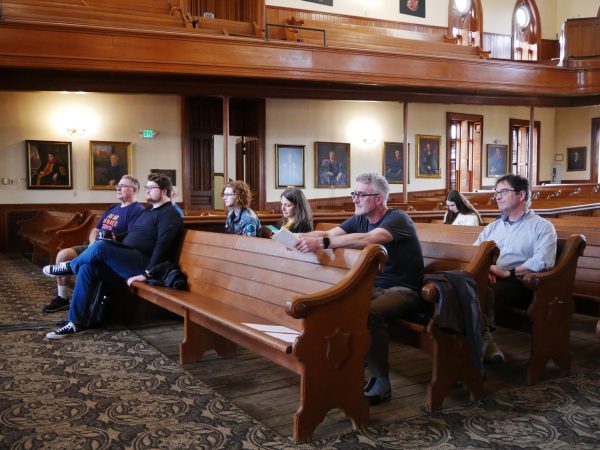
The event drew a mix of professors and students, with various readers donning political buttons, a Greek fisherman hat and a shirt proclaiming, “Read Banned Books.” Readers brought a plethora of styles to the stage, from Professor Pedar Foss’s expressive recitation of Apollodorus’s tale to first-year Nena Bednar’s rhythmic delivery of Platonic beauty standards. Three speakers incorporated German, French and Spanish into their respective passages, emphasizing Professor Howard Pollack-Milgate’s point that DePauw is “part of a global, historical circulation of this text.”
While DePauw’s Read-A-Thon emerged in response to the events at Texas A&M, academic freedom remains endangered on college campuses nationwide. In 2025 alone, 32 states proposed laws supporting censorship in higher education, and 21 of the 93 bills were passed across 15 states. Indiana has several laws that limit academic freedom and 14 bills that aim to restrict collegiate expression even further.
Indiana’s restriction of educational freedom extends beyond the government level; universities are now rejecting liberal arts and sciences, largely independent from legislation. Indiana University (IU) recently suspended 249 academic programs, including 22 degree programs at IU Bloomington. The majority of these programs are language- or art-related, indicating IU’s limited commitment to the liberal arts and sciences.
Amid Indiana’s threats to academic freedom, DePauw has demonstrated its commitment to the liberal arts. According to Alvarez, the Read-A-Thon aimed to “spur dialogue” regarding censorship among the DePauw community. The importance of this conversation has grown as restrictions on college campuses have grown. When asked about the value of academic freedom, Bednar maintained that it “is necessary to actually fulfill the purpose of education, which is to broaden your worldview.” In her eyes, seeing the world “critically” is a skill gained through a liberal arts education. In the absence of censorship, critical thinking can thrive, and students can form opinions without external influence. DePauw strives to defend students’ freedom of thought, a mission that stands in contrast to universities such as Texas A&M and IU Bloomington.
With the growing censorship across the U.S. and within Indiana, upholding educational freedom is both more important and difficult than ever before. The Read-A-Thon demonstrates DePauw’s commitment to opposing censorship in higher education. Still, the battle for academic freedom remains an ongoing process — one that requires continued action from students, professors and administrators.