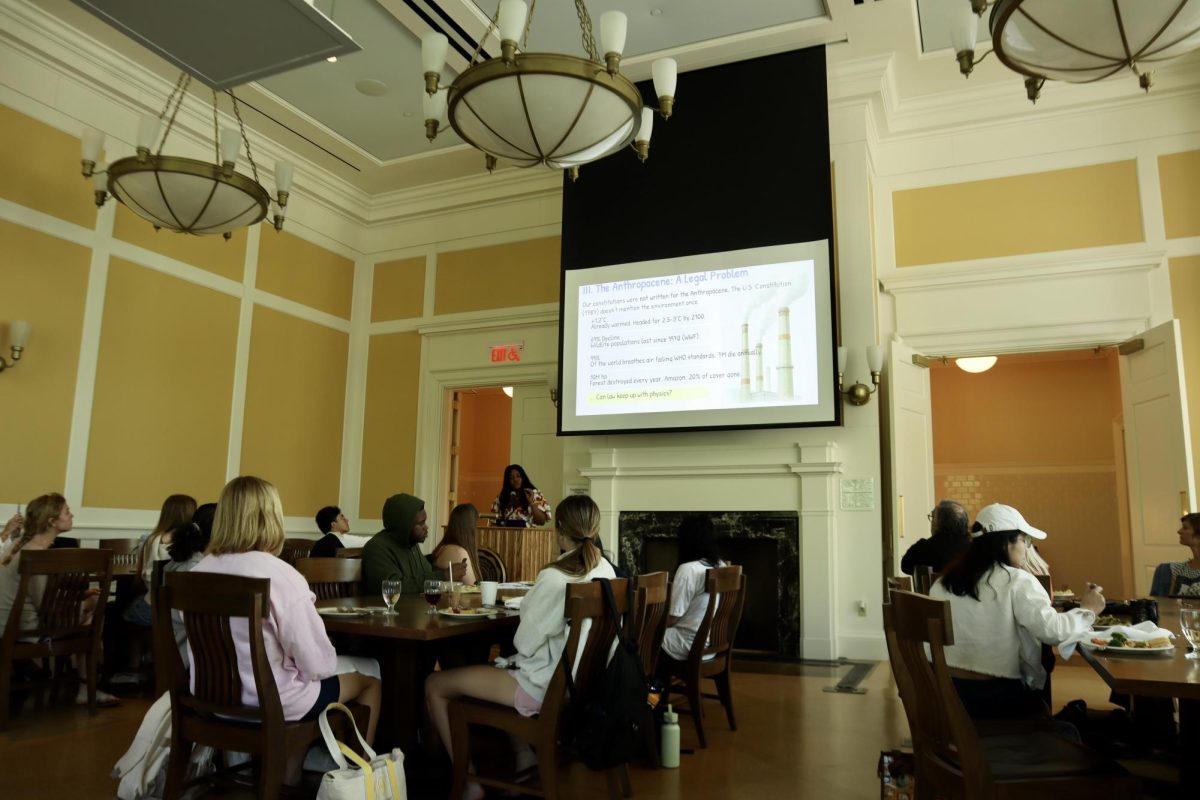
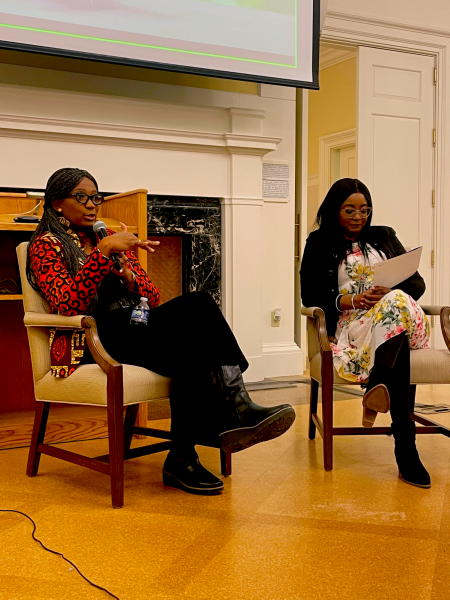
On Feb. 12, 2026, DePauw University hosted political scientist J. Jarpa Dawuni for the annual Boswell Symposium, where she explored how women move from “silence to sovereignty” in global politics and society. Dawuni was introduced by professor of Women’s, Gender and Sexuality Studies, Jennifer Mike, Ph.D.
The symposium began with a framework – takeoff, cruise, descend, touchdown. Using an airplane allegory, Dawuni described how women shape the frameworks of ethics, justice and scholarship.
She began the takeoff by explaining the difference between silence and sovereignty. Silence is a state of no sound, but silence requires action. In contrast, sovereignty is the exercise of absolute power. It is the ability for a group of people to elect who they want, and have control over aspects like land and airspace. So, this creates a paradox between silence and absolute control.
Connecting this outline to women’s rights, Dawuni said there is nowhere in this world where women’s voices have not been silenced. But the important question going forward is – what have women done to break it?
The cruise section of the symposium discussed mapping women’s global movements. This highlighted the struggle for women to gain the right to vote and the additional turmoil Black women faced when fighting for the same right.
She also discussed current events, such as the presidential election in Costa Rica on Feb. 5, where they elected their second female president, 39-year-old Laura Fernández. This was placed in a context of women making progress all around the world, while still facing persistent challenges based on gender, race and class.
Fewer than 30% of women serve in the U.S. Congress, and the United Nations has yet to elect a female Secretary-General since its founding in 1945. All this is despite women making up about 50% of the world’s population. With these simultaneous advancements and struggles, it is projected to take about 130 years to close the gender wage gap. Dawuni relayed these details and said, “Silence has been broken in some places, but sovereignty is yet to be fully achieved.”
This is where the descent began, and continental experiences were discussed. Dawuni focused on Africa, which she described as a very rich continent, but faces challenges due to its history. She combines her skills as a lawyer and political scientist to examine specific stories and statistics about women in Africa.
Dawuni historicized women’s roles in the continent and began in Benin, where she discussed the Agojie, also known as the Dahomey Amazons. This was an all-female military regiment that Benin honors with one of the tallest statues in the world, which depicts one of these female warriors.
In politics, the highest number of women lawmakers is in Rwanda, making up over 60% of their parliament. Additionally, the International Criminal Court had its first-ever female prosecutor, a woman from Gambia. Beyond politics, women play an important role in economics. The first woman to be elected as the Director-General of the World Trade Organization was a Nigerian woman named Dr. Ngozi Okonjo-Iweala.
Dawuni touched on other world issues that women have fought for, such as peace and the environment. In Ghana, women led a fight against colonial administration. This fight for liberation helped Ghana gain freedom from imperialism. Two Liberian women, Leymah Gbowee and Ellen Johnson Sirleaf, won the 2011 Nobel Peace Prize after helping end the Liberian Civil War and fighting for women’s rights. Women have also helped the environment by providing a continuous agricultural supply year-round.
Finally, Dawuni led us into the final step of the plane ride, the touchdown. She urged everyone to examine how the past informs the future and what this means for women’s rights. Dawuni left us with a proverb she said to remember: “When you strike a woman, you strike a rock.” She goes on to say that women are powerful and when you strike what they care about, they will fight back and riot.
Professor Mike concluded the symposium and added, “If there is something that I’ve learned tonight, it’s that I have agency.”
Women prove that silence is broken by acts of resistance, and that is how you gain sovereignty. The fight for women’s rights and gender equality is not linear, but acknowledging the history and evaluating where we want to be is a solid step towards change.