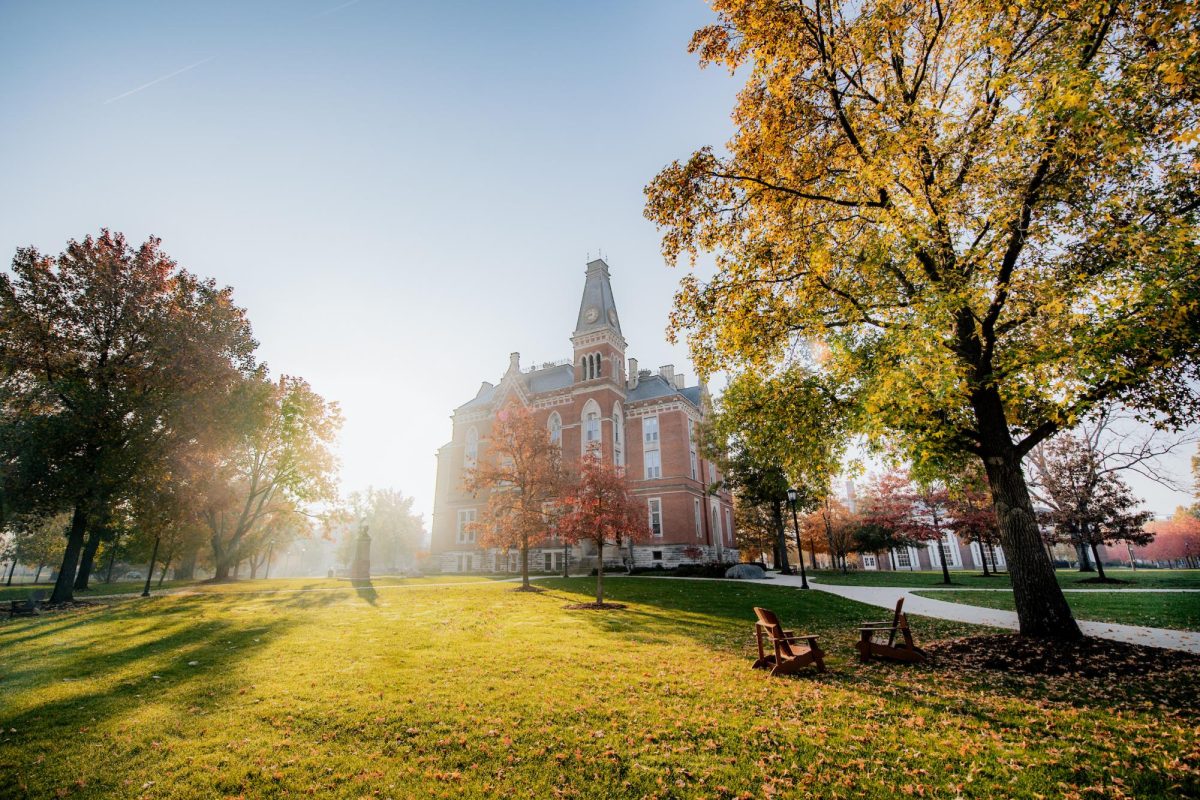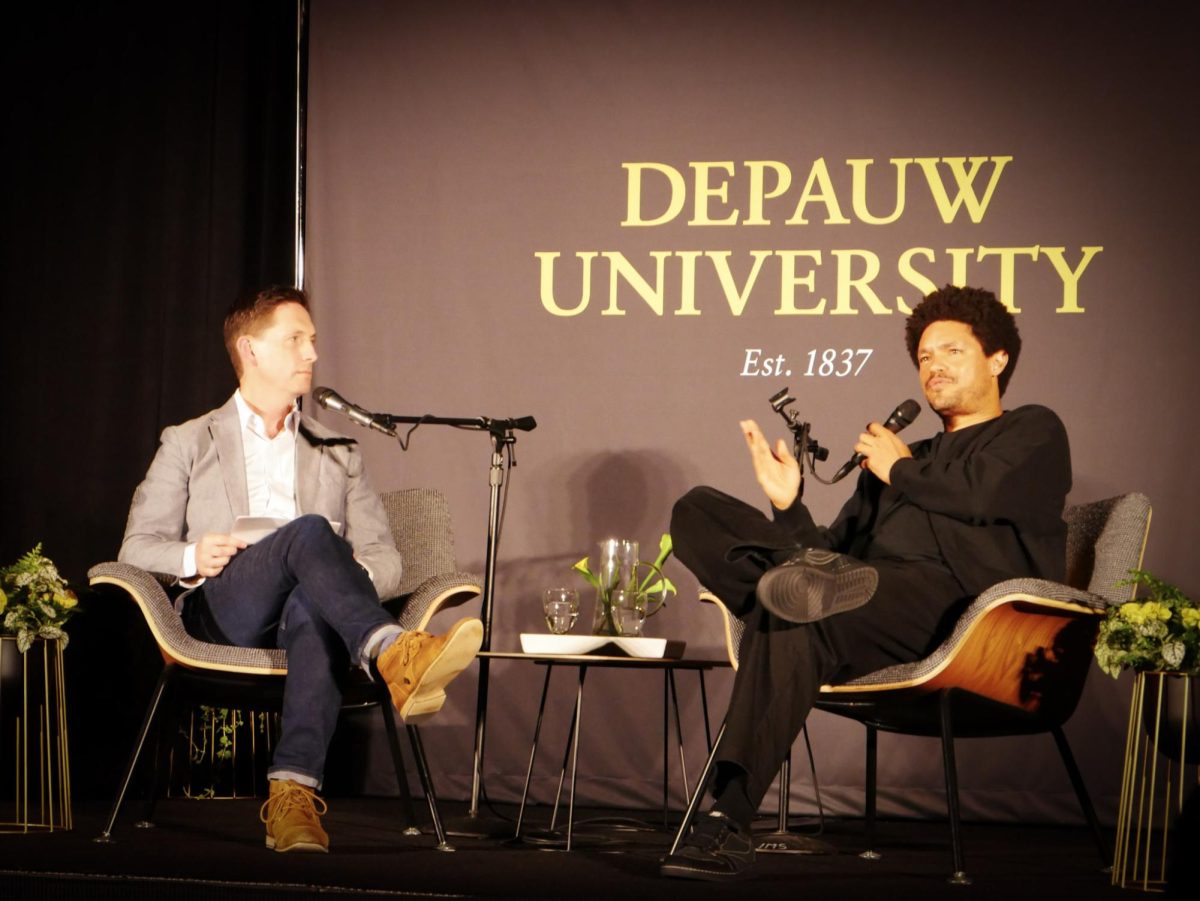
More than 40 years. 130 lectures. A legacy of impact. The last speaker event of the Ubben Lecture Series at DePauw University, featuring Trevor Noah, began with a trip down memory lane of others hosted in the past and the wisdom they had to offer, including notable figures like Malala Yousafzai, Margaret Thatcher, Bill Clinton, Jane Goodall, Jimmy Kimmel, Condoleezza Rice and many more. What started from a sketch on a paper napkin, President Lori S. White shared, blossomed into an ode to freedom of expression and a love for listening, questioning and growth that is at the heart of DePauw as an institution.
Claudio Martinez ‘26 introduced Noah by saying that he is one of the very few people who can make one laugh and think at the same time. And in the ensuing hour of conversation, banter and even a short segment inspired by “If I Ruled the World” from Noah’s “What Now” podcast, he did just that. In conversation with Jeffrey Dunn, director of the Prindle Institute for Ethics and associate professor of philosophy and subsequently Deepa Prakash, professor and chair of the political science department, Noah explored how various facets of his background and identity have come out in each of his professional roles as a comedian, writer, television host and political commentator.
In the first half of the evening, Dunn brought up inquiries that spanned heavy concepts of masculinity, self-examination and duality; Noah’s answers struck a balance between meaningful contemplation and witty humor. He delved into how people with different personality types have their own ways of recharging and how the comedian persona comes from a place of intentionally applying one’s skill to a professional platform. The speaker also gave some insight into how different his life is today from his childhood, but that “only someone else makes you realize how strange your life is,” as Noah’s dreams of making it never imagined something like hosting the Grammys, but instead being able to buy himself ice cream whenever he wanted.
Further along the conversation, a highlight for Dunn was Noah’s take on the manosphere and masculinity as he reflected on his own androgynous upbringing with a single mother, while also deconstructing why societal discourses choose to hyperfixate on gendered labels. Dunn appreciated Noah’s approach to their discussion and off-stage interactions throughout the evening with a genuine curiosity and effortless charisma, an inspiration for the professor to ask more questions with a willingness to learn.
Dunn and Prakash were chosen as interviewers by the Office of the President, and their close, playful friendship worked well to create a light-hearted transition to the second half of the evening, as the professors each pitched one concept they thought would meaningfully add to society, with Noah as the judge. While the pair had initially agreed to keep their ideas a surprise to one another, they eventually shared them before the interviews and found such a comic contrast between Dunn’s mandatory community learning for adults and Prakash’s plea to “free us from the tyranny of fries” with small plate options for every item on a restaurant menu, that they were all the more excited to perform the bit on stage. In the end, the former pitch won, much to the latter’s chagrin.
Prakash then had stage time alone with Noah to present questions from students, faculty, administrators and Greencastle community members. An especially relevant question to the uncertainty for international students and immigrants in the US today asked Noah about his experience of belonging, in response to which he advised the audience to “resist the allure of being on the inside,” as even though being an outsider can be uncomfortable, it is a gift. This theme of identity and intersectionality continued as Noah explored the role of politics and honesty in social dynamics today, stating that the act of grappling, making mistakes and asking dumb or seemingly obvious questions is what supports true learning and can uncover surprising possibilities. Prakash further emphasized the poignance of his point about getting to know people over “unimportant things” first, rather than “leading with complexity” that could divide us. In the absence of unlimited time, the question of why, even as the seemingly perfect atmosphere to make connections and be open to different perspectives, colleges may be failing to do this, was left unasked. Nevertheless, Prakash commended Noah’s ability to provide the catalyst needed to spark conversation on this thought-provoking topic.
Noah concluded his time on stage by acknowledging that the current state of the world can make young people feel like there is nothing waiting on the other side. He thus encouraged us to step up, like generations before us, and be the architects of the world we want to live in.
Vice President for Inclusive Engagement Dionne Jackson affirmed that “bringing the world to DePauw and to a small town like Greencastle has expanded the horizons of students for decades.” So, although this is the last speaker the university will host for the lecture series, the donation by Sharon Ubben and the late Timothy Ubben will continue to help the DePauw community flourish in the form of student scholarship.
A toast to old DePauw, in the words of Sharon Ubben, “the song has ended, but the melody continues on.”