


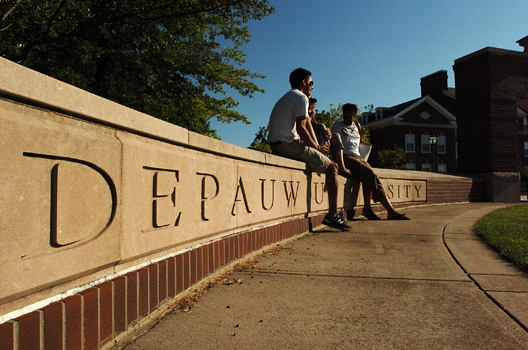
On September 7, 2016, an article appeared in The DePauw hailing the creation of Rainbow Floor, a residential floor for members and allies of the LGBT community.
While the article covered the benefits of Rainbow Floor, it failed to acknowledge the harm of such housing. May a campus be deemed diversified when the administration actively creates segregated housing? Does it hinder the ability of LGBT students to confront challenges they will face outside of the DePauw bubble? Is it healthy to allow students the option of not integrating with students dissimilar to themselves in a residential setting? Does it foster an us-them dynamic?
The easiest way to justify segregated housing is to exaggerate any incident to create beneficial talking points. Students and faculty are guilty of making dramatic, reckless statements on campus discrimination, such as “the students are afraid for their lives,” “There’s transgender people who get killed for walking into the wrong bathroom,” and “asked for the location of the Rainbow Floor not to be published for the privacy and safety of its residents.”
To be clear: I am not trivializing property damage or verbal assault in the least; these are serious offenses and require attention. However, I am asking that deeper analysis is given to such comments that suggest DePauw students are capable of murder, or that a floor’s location cannot be disclosed because of such security concerns (located on a campus of only 2,400 students and accessible to others who reside in the building).
Similarly, the easiest way to dismiss any opinions that challenge the housing decision is to throw phrases out like “heterosexual privilege,” and “safe space.” While these phrases may effectively chill the articulation of any opposition, it does not enable debate on the substance of the topic. DePauw is better than that and its students should thoughtfully engage in rational debates with opinions that differ from their own.
I encourage the student body to rigorously debate this challenging topic before segregated housing divides a campus into pockets of students, undermining our efforts at diversity and integration.









photoguy • Feb 17, 2017 at 12:27 pm
How ironic it is that the comments below are arguing about an unwelcoming campus and “why such housing choices are necessary,” when the conversation could be about the benefits of a diverse housing community? And how ironic it is that DPU has such an aspiration for students to experience international travel, and international students on campus, and we don’t seem to be aspiring to find out how to maximize the benefits of these opportunities? I think the phrase “segregated housing” just set off the firestorm here. Don’t take that bait, refute it and take the issue where it should go.
annabel • Oct 3, 2016 at 7:27 pm
Again, at my daughter’s college, they have designated floors for people of color; I’m not sure about sexuality. I grew up in boston. I remember busing in the 70’s. We fought hard for black kids to be able to be bused to decent schools in white neighborhoods to get the same education. Now groups want to segregate themselves again? If it was bad then, what makes it good now? segregation sucked then and it sucks now. I find if very perplexing and a tad hypocritical.
Brigid • Oct 3, 2016 at 5:05 pm
Have any LGBT students have been murdered on campus for walking into the wrong bathroom? How many students have been targeted for assault/murder in their rooms? When did these attacks/murders take place?
roccolore • Oct 2, 2016 at 8:47 pm
Racist blacks lecture on diversity, then advocate segregation.
Tim Good • Sep 29, 2016 at 6:11 pm
These are not dramatic, reckless statements, and you are absolutely trivializing the lived experiences of members of our community. Our brothers and sisters who face this level of hate actually, really, fear for their lives. This is not a point of view; it’s a fact.
Ask rather, why would such a housing choice be necessary? (And it IS a choice, not forced segregation, as you imply.) What have each of us done to subconsciously contribute to the unwelcoming campus? I’m not even sure what your point is. What is it that you’re protesting? If it’s that LGBT friends and colleagues are safe anywhere on campus, that is simply not true. If you don’t want certain members of our community to be able to feel safe, that needs to be articulated more clearly.
Matthew Cummings • Sep 29, 2016 at 4:32 pm
Hey Mike, how is this segregated housing? Please do not rewrite history that undermines the oppression and systematic racism that was perpetuated by dominant powers and attempt to connect it to a FLOOR in an entire RESIDENCE HALL (you know where people interact with other people in multiple floors, lobbies, and spaces) that is aimed at giving life, purpose, and validity to one’s existence.
wow • Sep 29, 2016 at 4:42 pm
Oh boy. Someone’s angry. I hope you’re not a professor.
Katia Satterfield • Sep 29, 2016 at 2:47 pm
I couldn’t disagree more. More so, I’m embarrassed that a fellow DePauw alum would presume to know so much about what’s “best” for students with other experience. How can you encourage “rigorous debate” when you so obviously believe there’s only one correct outcome?
Regardless of the importance of navigating the boundaries between inclusion and exclusion, safe and secluded, it is not your place to determine how that happens. You don’t get to decide what statements are exaggerations or reckless, because it’s not your experience. You don’t say what conditions induce fear because you have much less to be afraid of. You can’t determine if any student is capable of murder (however unlikely), because you likely do not see the hateful side of most people.
There’s a reason there isn’t much productive discussion about inclusion, and it’s not because of terms like “privilege” and “safe space.” It’s because of opinions like yours, Mike–opinions that don’t listen to the needs of others.
I would like DePauw to be better than those kind of opinions. Only when we begin to listen can the discussions that we pride ourselves on actually occur.
Katia Satterfield
Class of 2011
P.S. “Is it healthy to allow students the option of not integrating with students dissimilar to themselves in a residential setting? Does it foster an us-them dynamic?” DePauw has been doing this since the 19th century. It’s called “the greek system,” so unless you’re going to question that tradition, don’t question the Rainbow Floor on this principle.
wow • Sep 29, 2016 at 4:32 pm
I didn’t take it as Mike thinking there is just “one correct outcome”. I think you read his opinion and obviously got offended. I think you fall into his mention of needing “safe places.” Should there have been a triggered warning in this opinion piece too? God forbid someone comes forward to discuss an opposing opinion and all you can do is say he’s the reason nothing productive happens. And here’s the thing, I’m all for the Rainbow Floor but its responses like yours that bother me to no end. And then bringing in the Greek system, come on. Typical GDI! (Okay, maybe that was slightly relevant).
Katia Satterfield • Sep 29, 2016 at 6:45 pm
Nah, “wow,” you’ve got me wrong. To be fair, there is a chance I also read Mike, wrong. But I will tell you that I started reading his letter very openly, and my reaction quickly sank as I saw him belittle statements from DePauw students and professors, and then turn to an attack on media’s favorite buzzwords. By the end, I felt Mike clearly had an opinion against the ideas of privilege and safe spaces, and he wanted to voice that at all costs, but try to frame it with something vaguely intellectual.
But let’s talk about me, because that’s the core of your reply, wow, and I want to elucidate my motives. I did not take offense at what was written; I was disgusted. I’ve been blessed (dare I use the word “privileged”, or will that be a strike against me?) to live a life free of lasting, traumatizing events. I’ve never felt the need for a safe space.
What I haven’t always done is listen to what other people say they need to live healthy lives. At DePauw, I was active in a lot of things, mostly related to sustainability. However, I was definitely oblivious to much about what it meant to be a person of color on DePauw’s campus. That ignorance is something I deeply regret. In 2012, I started to hear vocal stories about DePauw students of color’s feelings of unwelcomeness, and I feel I probably contributed to that in some implicit way. DePauw students don’t deserve that, and I want it to change.
You see, I care about DePauw, and I care about the experience of everyone who goes through. Campuses have different cultures–that’s why we choose colleges–but that doesn’t mean everyone has to assimilate. Homogeneity gets you nowhere long term, and the sooner DePauw (as an institution and as a body of 2,400 students) can get past the tendency to exclude those who don’t blend, the better an education and experience a DePauw degree will be.
You’re right about me in one way: I do have some experience with this exclusion as an independent student. I started off my second semester freshman year very comfortable with the fact that some of my best friends were in greek houses and I was not, but by senior year, the dynamic really wore on me. The dominance of greek life had a negative effect on my well-being, no matter my attitude toward it. While I recognize that it will never go away (I’m not advocating for that), I’m not going to let Mike’s argument about not integrating students of dissimilar identities pass un-noticed in a school whose social life is built on self-identifying physical, residential houses.
I want to point out one more thing that I truly do feel is “reckless” language: Mike’s use of “DePauw bubble.” The idea of the “bubble” is that we don’t face challenges at DePauw that we will outside, after graduation. OK, he used it consistently there. But the way he employed it, he speaks of people who ARE experiencing challenges in and outside of DePauw, and saying that DePauw (an institution that should be helping to NURTURE all students) shouldn’t do anything to mitigate those. But what of the people with privilege (of all types)? When I think of the Bubble, I think of the people who live inside it, never challenging their own perspective and that someone else may have a different experience. I think of myself. Mike and wow, won’t you challenge yourself to be uncomfortable and see where others are hurting? There’s a big world outside the Bubble.
wow • Sep 29, 2016 at 10:20 pm
“Mike and wow, won’t you challenge yourself to be uncomfortable and see where others are hurting? There’s a big world outside the Bubble.”
I think you’ve got me wrong now. Or at least my comment. You said you began reading his letter with an open mind but “By the end, I felt Mike clearly had an opinion against the ideas of privilege and safe spaces, and he wanted to voice that at all costs, but try to frame it with something vaguely intellectual.” Perhaps he did, perhaps he didn’t. It’s very hard to tell exactly what someone is like and their personal beliefs from 1 oped in a school news paper. My point was your response was to attack his character and call people like him the root of the problem. Wouldn’t a better alternative have been to point out what you believe to be his obvious ignorance and help shed light on the challenging lives that others lead? Attacking someone the way you did seems like a sure fire way to make them become more defensive and extreme in their position. If your goal was to get him to think more like you, you might want to try a different approach.