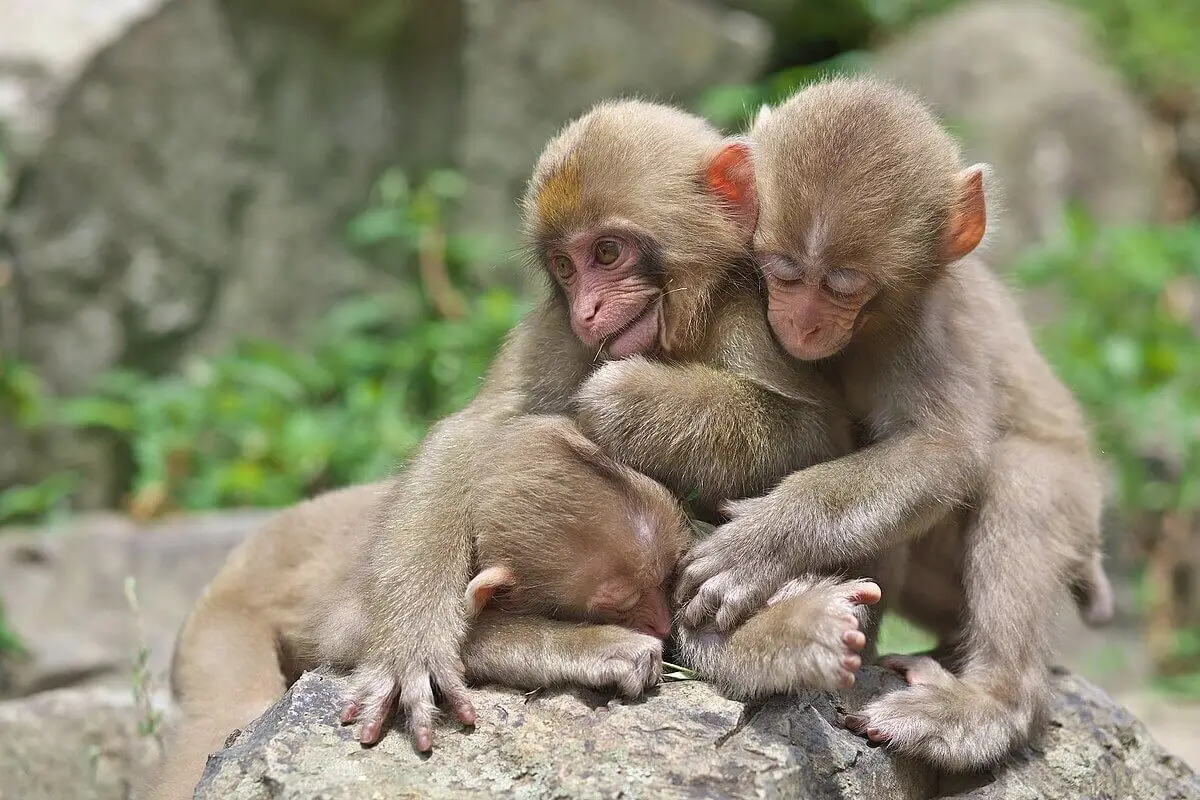
If you search “Punch the Monkey” on Google, you may notice your screen fill up with hearts — inside, the image of a small macaque monkey cuddling the arm of a stuffed orangutan. That monkey, named Punch, was born in July 2025 at the Ichikawa City Zoo, where he was quickly abandoned by his mother, who, as theorized by zookeepers, may have been prioritizing her own health during a heat wave. Since then, Punch has become an outcast amongst the other macaque monkeys.
The monkey gained international fame when videos of him running to his stuffed orangutan after being bullied by fellow monkeys surfaced on social media. Punch quickly became the subject of tragic, sympathetic TikTok edits — some with captions like “I have maternal instincts for Punch,” and others set to songs like John Lennon’s “Beautiful Boy.” In any case, TikTok users came running to Punch’s side, hoping he would soon find a friend. He even drew large crowds to the Ichikawa City Zoo located in Japan — around 8,000 on Valentine’s Day weekend — many with their own stuffed primates to carry around. Businesses also got in on the action, such as IKEA, which sent a batch of the toy directly to the zoo. To the relief of internet users around the world, recent videos show Punch interacting with another monkey — getting groomed and receiving hugs.
Some online users have compared Punch’s experience to the 1965 experiment by psychologist Harry Harlow, which tested how comfort and companionship impacted infant attachment. TikTok user “girlytakes” posted footage of the experiment, captioned, “psych majors know the original punch.” In the experiment, infant rhesus monkeys were socially isolated and given two surrogate mothers: one made of wire, which had milk, and the other made of cloth, which had no milk. Harlow’s study found that the infants would cling to the cloth mother, proving his theory about the importance of physical contact and comfort in childhood development.
Of course, Punch is not the first cute baby animal to gain the support of the entire internet. Some may remember Moo Deng, a young pygmy hippopotamus who rose to fame in September 2024. While trending, Moo Deng doubled the daily visitors at her home zoo, Khao Kheow Open Zoo, and even appeared on SNL’s “Weekend Update” — or at least, a version of her played by cast member Bowen Yang. However, Moo Deng’s popularity quickly dwindled. On the Khaw Kheow Open Zoo Instagram, early posts of the hippo received nearly 70,000 likes. Later posts, however, received as few as 600. This phenomenon begs important questions about the speed of internet trends and whether Punch may soon be left in the dust.
When asked about Punch’s internet fame, DePauw student Polina Nix ‘29 commented, “I think his popularity is already starting to fade, but I did see that he’s in Roku City now, so who knows.” Nix said she first saw the monkey on TikTok and immediately found him to be “absolutely darling.” Katherine Fogarty ‘28 argued that Punch, like other famous animals, will “slowly lose traction.”
Whether Punch has lasting fame or not, his popularity, born out of sympathy and care, proves that the internet is not yet entirely devoid of emotional impact. In fact, Punch may be the perfect example of the internet’s collective ability to make change if the cause has a cute enough face.